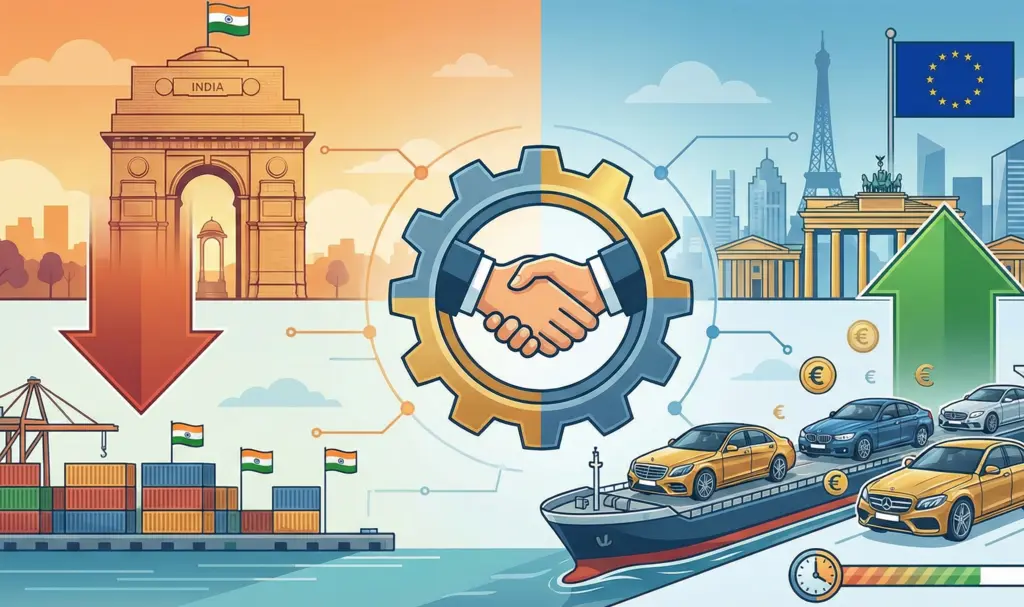
India and the European Union (EU) are reportedly advancing significantly in negotiations for a comprehensive Free Trade Agreement (FTA), with a pivotal development emerging in the contentious automotive sector. Reports indicate New Delhi is considering a substantial reduction in import duties on completely built units (CBUs) of cars, proposing a cut from the current peak of 110% to approximately 40%. This potential policy shift represents a critical juncture in India’s international trade strategy, balancing the demands of global integration with the necessity of shielding domestic industrial interests.
The Mechanics of the Proposed Tariff Cut
For decades, India has maintained some of the highest automotive import duties in the world. Currently, completely built units (CBUs) face tariffs ranging from 70% to 110%, depending on the vehicle’s engine size and customs value. This protectionist stance was designed to encourage global manufacturers to set up local production facilities under the “Make in India” initiative.
The reported proposal to slash these duties to 40% represents a major concession. However, it is rarely a sudden transition. Trade experts suggest that such a reduction would likely be implemented over a phased period—potentially five to ten years—to allow the domestic industry time to adjust to increased competition from European luxury and high-performance brands.
Implications for European Manufacturers
The primary beneficiaries of this policy shift would be European automotive giants, particularly those based in Germany, France, and Italy. Brands such as Mercedes-Benz, BMW, Audi, and Volkswagen have long identified the Indian middle and upper-middle class as a vital growth demographic.
High tariffs have historically relegated many European models to a “super-luxury” price bracket, out of reach for many prospective buyers. A reduction to 40% would significantly lower the “on-road” price of imported vehicles, potentially triggering a volume surge for European marques and allowing them to compete more effectively with premium vehicles assembled locally.
The Domestic Perspective and “Make in India”
While the move is welcomed by international trade advocates, it remains a point of contention for domestic manufacturers and the Society of Indian Automobile Manufacturers (SIAM). The Indian automotive sector contributes approximately 7% to the national GDP. Local players like Tata Motors and Mahindra & Mahindra, along with global firms that have invested heavily in Indian factories (such as Hyundai and Suzuki), have expressed concerns that lower tariffs might disincentivize local manufacturing.
To mitigate these concerns, the Indian government is expected to balance the tariff cuts with strict “Rules of Origin” and perhaps quotas on the number of vehicles that can be imported at the lower rate. This ensures that the deal does not lead to a “hollowing out” of the domestic supply chain.
The Broader Context: A Reciprocal Trade Deal
The reduction in car tariffs is not an isolated event but a “give-and-take” component of the India-EU FTA. In exchange for opening its automotive sector, India is seeking better access to the European market for its own core industries. Key areas of interest for New Delhi include:
- Textiles and Leather: Lowering entry barriers for Indian-made apparel and footwear.
- Labor Mobility: Easier visa norms and “Mode 4” services, allowing Indian professionals (IT, healthcare, engineering) to work more easily within the EU.
- Agricultural Products: Streamlining sanitary and phytosanitary (SPS) standards that often hinder Indian exports.
The reported move to slash automobile tariffs from 110% to 40% is a clear indicator of India’s maturing economy and its willingness to integrate more deeply with global supply chains. By lowering these barriers, India is signaling a shift from a purely protectionist stance to one of strategic competitiveness.
While the final details of the trade deal remain subject to high-level diplomatic maneuvering, the direction is clear: a more open Indian market that offers greater choice to consumers, while challenging domestic manufacturers to elevate their global competitiveness. For the EU, it represents a hard-won victory in accessing one of the world’s last great frontier markets for the internal combustion engine and the burgeoning electric vehicle sector alike.