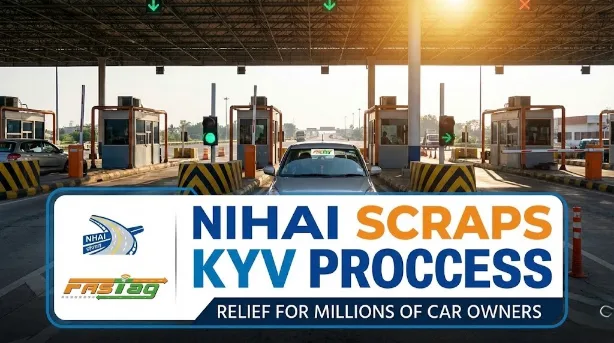
National Highways Authority of India has decided to discontinue the routine Know Your Vehicle (KYV) requirement for FASTag issuance, a move aimed at simplifying the process for private vehicle owners and reducing post-issuance inconvenience. The revised process will come into effect from February 1, 2026, and will apply to cars, jeeps, and vansusing FASTag on national highways.
The decision marks a significant change in how FASTags are verified and activated. Until now, vehicle owners were often required to complete KYV verification even after a FASTag had already been issued and activated, leading to delays, repeated follow-ups, and occasional service disruptions.
What Was the KYV Process and Why It Was Introduced
The KYV process was introduced to ensure that FASTags were correctly linked to the vehicles they were issued for and to prevent misuse, duplication, or tagging errors. Under this system, vehicle owners were asked to submit additional details after FASTag issuance, including photographs of the vehicle, number plate, and FASTag placement, along with registration information.
While the intent was to improve system integrity, the implementation created friction for many users. In several cases, vehicle owners were asked to complete KYV weeks or even months after their FASTag had become operational, sometimes resulting in temporary restrictions until verification was completed.
What Has Changed Under the New Rules
Under the revised framework, routine KYV will no longer be mandatory for passenger vehicles. FASTags issued for cars, jeeps, and vans will not require post-activation KYV as a standard step. Existing FASTags already in use will also be exempt from mandatory KYV unless a specific issue is identified.
KYV will now be conducted only in exception-based scenarios, such as cases involving suspected misuse, incorrect vehicle tagging, customer complaints, or discrepancies flagged by the system. In the absence of such issues, users will not be required to submit additional verification documents after activation.
This change is expected to significantly reduce administrative burden for both users and issuing banks.
Stronger Pre-Activation Verification to Replace KYV
To compensate for the removal of post-activation KYV, NHAI has strengthened pre-activation verification requirements. Issuing banks will now be fully responsible for ensuring that vehicle details are verified before a FASTag is activated.
Vehicle data will be validated primarily through the VAHAN vehicle registration database, which contains official registration records maintained by transport authorities. FASTags will only be activated once the vehicle details match records available in the database.
In cases where vehicle data is not available digitally, banks will be required to verify details using the vehicle’s Registration Certificate (RC) before activation. Banks and issuing entities will be held accountable for any FASTags activated without proper verification.
Impact on FASTag Users
For most private vehicle owners, the removal of mandatory KYV is expected to lead to a smoother and faster FASTag experience. Users will no longer face unexpected requests to upload vehicle photographs or documents after activation, reducing confusion and inconvenience.
The updated process also lowers the chances of temporary FASTag restrictions due to incomplete KYV, an issue that had previously affected some users despite valid documentation being submitted at the time of purchase.
Overall, the change is expected to improve user satisfaction while maintaining adequate safeguards against misuse through stronger upfront checks.
What Does Not Change
While routine KYV has been removed, NHAI has clarified that verification can still be carried out when necessary. If a FASTag is flagged for incorrect usage, linked to the wrong vehicle, or involved in a dispute, KYV may still be required to resolve the issue.
The FASTag system itself continues to remain mandatory for toll payments on national highways, and all existing rules related to usage, balance maintenance, and compliance remain unchanged.
Why This Move Matters
FASTag has become the backbone of electronic toll collection in India, enabling faster movement at toll plazas and reducing congestion. As adoption has scaled up nationwide, simplifying the user experience has become a priority.
By shifting verification entirely to the pre-activation stage and making KYV exception-based, NHAI is aligning FASTag operations with broader digital governance practices that emphasise upfront validation and minimal post-issuance friction.
The move also reflects increased confidence in national vehicle databases and digital verification systems, reducing reliance on manual document uploads by users.
Implementation Timeline and What Users Should Do
The revised KYV rules will apply to all new FASTags issued from February 1, 2026 onwards. Existing FASTag users do not need to take any action unless they are specifically contacted due to a flagged issue.
Vehicle owners planning to purchase a new FASTag should ensure that their vehicle registration details are accurate and updated in official records, as verification will now happen before activation rather than after.
What to Expect Next
NHAI is expected to issue further operational guidelines to issuing banks and FASTag service providers to ensure uniform implementation of the new rules. Banks and dealerships are also likely to update their onboarding processes to reflect the strengthened pre-activation checks.
With the removal of routine KYV, FASTag issuance and usage for private vehicles is set to become more streamlined, reducing friction for users while maintaining the integrity of India’s electronic toll collection system.