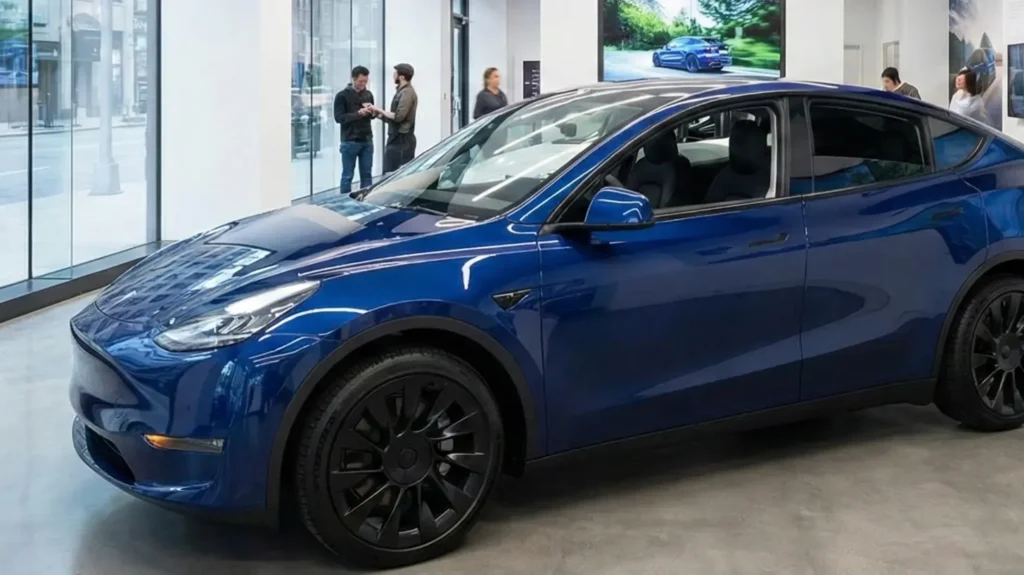
Just over six months after its official entry into the Indian market, Tesla has introduced a price correction for its Model Y electric crossover. The manufacturer is offering a discount of up to Rs 2 lakh on specific units of the MY2025 inventory, a move aimed at addressing a significant surplus of unsold stock. This adjustment brings the ex-showroom price of the affected variant down to Rs 59.89 lakh.
Inventory Challenges and Sales Performance
Despite securing approximately 600 initial bookings during its launch phase, Tesla’s retail momentum in India has faced hurdles. Data from the Vahan portal indicates that only 226 units of the Model Y were registered in the 2025 calendar year. Reports suggest that out of an initial shipment of 300 vehicles, roughly 100 units remain in search of buyers. This discrepancy between early interest and final sales is attributed to several prospective customers reportedly withdrawing their bookings.
Specifics of the Discount Offer
The current incentive is not applicable across the entire range but is restricted to a specific configuration to streamline inventory clearance. The offer details include:
- Variant: Model Y Standard Range
- Exterior Color: Stealth Grey
- Interior Theme: All-black
- Revised Pricing: Rs 59.89 lakh (Ex-showroom)
- Availability: Limited to existing MY2025 stock
Market Context and Competitive Landscape
The sluggish sales performance can be traced to several strategic and economic factors. Unlike some competitors, Tesla failed to secure import duty concessions from the Indian government, leaving the Model Y subject to CBU (Completely Built Unit) duties of up to 110 percent. Additionally, the brand’s retail presence remains limited compared to established luxury players. In the Indian market, the Model Y competes directly with other premium electric SUVs, including:
- Mercedes-Benz EQA
- BMW iX1
- Kia EV6
The pressure in India mirrors global trends for the automaker. Tesla has seen its market share challenged in the US, Europe, and China due to increasing competition from manufacturers like BYD and the reduction of EV subsidies in several key regions.